I did some updates on my Cumulus Linux Vagrant topology and added new functions to my post about an Ansible Playbook for the Cumulus Linux BGP IP-Fabric.
To the Vagrant topology, I added 6x servers and per clag-pair, each server is connected to a VLAN and the second server is connected to a VXLAN.
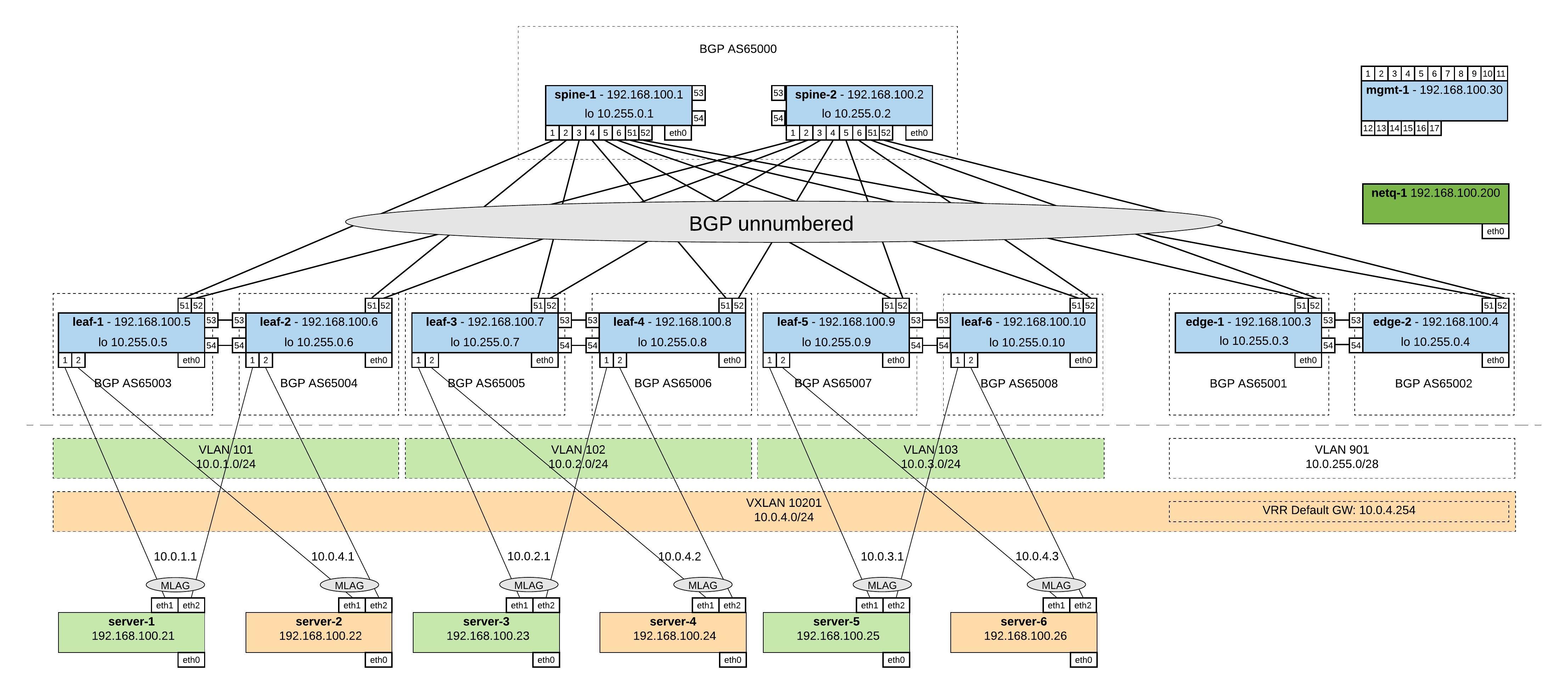
Here are the links to the repositories where you find the Ansible Playbook https://github.com/berndonline/cumulus-lab-provision and the Vagrantfile https://github.com/berndonline/cumulus-lab-vagrant
In the Ansible Playbook, I added BGP EVPN and one VXLAN which spreads over all Leaf and Edge switches. VXLAN routing is happening on the Edge switches into the rest of the virtual data centre network.
Here is an example of the additional variables I added to edge-1 for BGP EVPN and VXLAN:
group_vars/edge.yml:
clagd_vxlan_anycast_ip: 10.255.100.1
The VXLAN anycast IP is needed in BGP for EVPN and the same IP is shared between edge-1 and edge-2. The same is for the other leaf switches, per clag pair they share the same anycast IP address.
host_vars/edge-1.yml:
---

loopback: 10.255.0.3/32

bgp_fabric:
  asn: 65001
  router_id: 10.255.0.3
  neighbor:
    - swp51
    - swp52
  networks:
    - 10.0.4.0/24
    - 10.255.0.3/32
    - 10.255.100.1/32
    - 10.0.255.0/28
  evpn: true
  advertise_vni: true

peerlink:
  bond_slaves: swp53 swp54
  mtu: 9216
  vlan: 4094
  address: 169.254.1.1/30
  clagd_peer_ip: 169.254.1.2
  clagd_backup_ip: 192.168.100.4
  clagd_sys_mac: 44:38:39:FF:40:94
  clagd_priority: 4096

bridge:
  ports: peerlink vxlan10201
  vids: 901 201

vlans:
  901:
    alias: edge-transit-901
    vipv4: 10.0.255.14/28
    vmac: 00:00:5e:00:09:01
    pipv4: 10.0.255.12/28
  201:
    alias: prod-server-10201
    vipv4: 10.0.4.254/24
    vmac: 00:00:00:00:02:01
    pipv4: 10.0.4.252/24
    vlan_id: 201
    vlan_raw_device: bridge

vxlans:
  10201:
    alias: prod-server-10201
    vxlan_local_tunnelip: 10.255.0.3
    bridge_access: 201
    bridge_learning: 'off'
    bridge_arp_nd_suppress: 'on'
On the Edge switches, because of VXLAN routing, you find a mapping between VXLAN 10201 to VLAN 201 which has VRR running.
I needed to do some modifications to the interfaces template interfaces_config.j2:
{% if loopback is defined %}
auto lo
iface lo inet loopback
    address {{ loopback }}
{% if clagd_vxlan_anycast_ip is defined %}
    clagd-vxlan-anycast-ip {{ clagd_vxlan_anycast_ip }}
{% endif %}
{% endif %}
...
{% if bridge is defined %}
{% for vxlan_id, value in vxlans.items() %}
auto vxlan{{ vxlan_id }}
iface vxlan{{ vxlan_id }}
    alias {{ value.alias }}
    vxlan-id {{ vxlan_id }}
    vxlan-local-tunnelip {{ value.vxlan_local_tunnelip }}
    bridge-access {{ value.bridge_access }}
    bridge-learning {{ value.bridge_learning }}
    bridge-arp-nd-suppress {{ value.bridge_arp_nd_suppress }}
    mstpctl-bpduguard yes
    mstpctl-portbpdufilter yes

{% endfor %}
{% endif %}
There were also some modifications needed to the FRR template frr.j2 to add EVPN to the BGP configuration:
...
{% if bgp_fabric.evpn is defined %}
 address-family ipv6 unicast
  neighbor fabric activate
 exit-address-family
 !
 address-family l2vpn evpn
  neighbor fabric activate
{% if bgp_fabric.advertise_vni is defined %}
  advertise-all-vni
{% endif %}
 exit-address-family
{% endif %}
{% endif %}
...
For more detailed information about EVPN and VXLAN routing on Cumulus Linux, I recommend reading the documentation Ethernet Virtual Private Network – EVPN and VXLAN Routing.
Have fun testing the new features in my Ansible Playbook and please share your feedback.